Core Functionalities
Alignment of Network Capabilities and Entitlement Verification

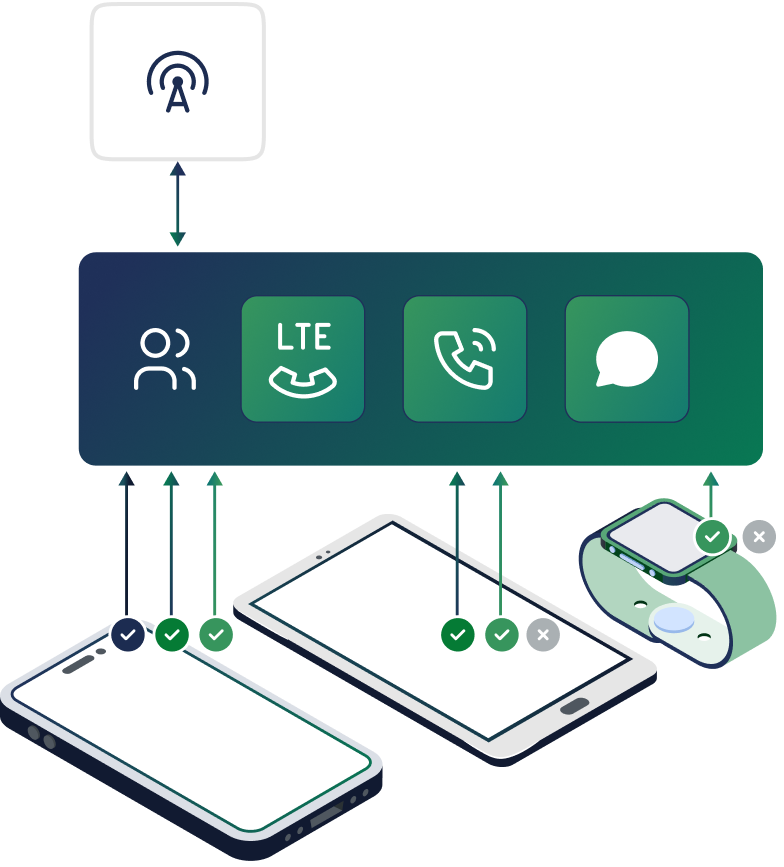
Operating autonomously in the background, the ES aligns device configurations with network capabilities across a wide variety of user equipment and platforms. As new device types enter the market—ranging from eSIM-only smartphones to wearables and tablets— the ES dynamically verifies and enforces entitlements, adapting instantly to changes in user status, active plans, or device migrations. It also supports quality-of-service enforcement by interfacing with policy control functions (PCRF), ensuring users receive the performance levels their entitlements specify.
Beyond feature access, the ES keeps devices updated with accurate service availability status, reducing confusion and directing users to alternative solutions when temporary limitations or outages occur. It provides operators with a powerful, standards-aligned mechanism to manage increasingly complex entitlements across their growing device base—without requiring disruptive changes to legacy systems.
Orchestration of Multi-Step Processes
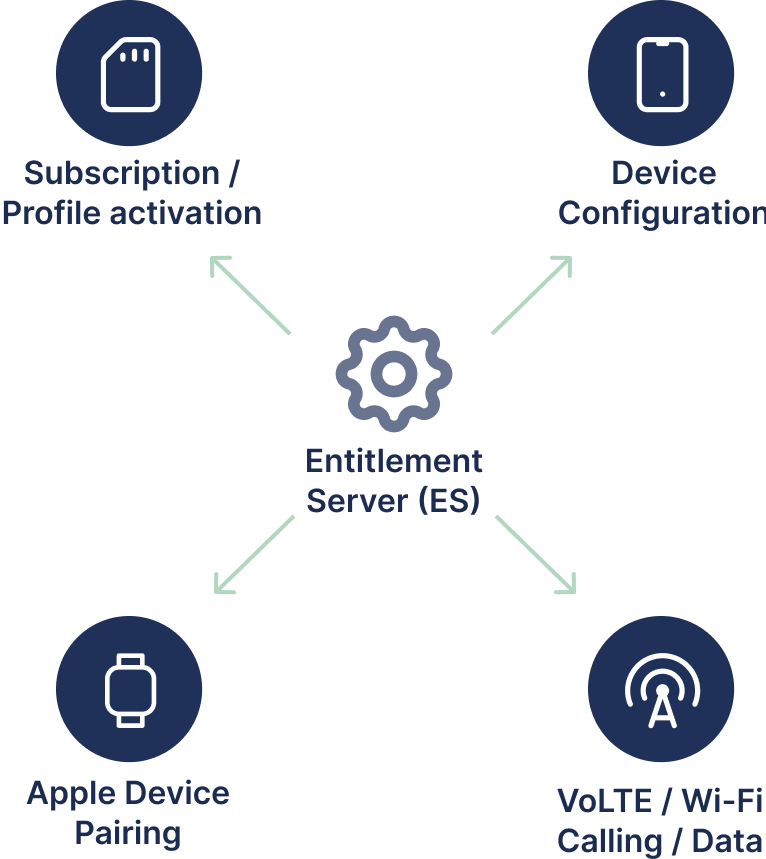
Rather than relying on manual configuration or fragmented backend flows, the ES automates these processes end-to-end—enabling seamless, scalable service delivery across the operator’s entire subscriber base.
Key orchestration capabilities also include subscription transfers between devices, allowing users to migrate their number, and plan to a new device—such as an iPhone upgrade—without needing to contact an operator. It handles activation of secondary devices like smartwatches with precision, whether tied to the same mobile phone number or part of a family plan with dedicated service entitlements. These wearable use cases benefit from fast, error-free provisioning, enabling out-of-the-box functionality and ensuring synchronized user experiences across devices.
Automation of ES, policy enforcement, and profile delivery significantly lightens the load on customer care and IT operations. The ES acts as a gatekeeper, enforcing security policies by validating device and SIM identities.